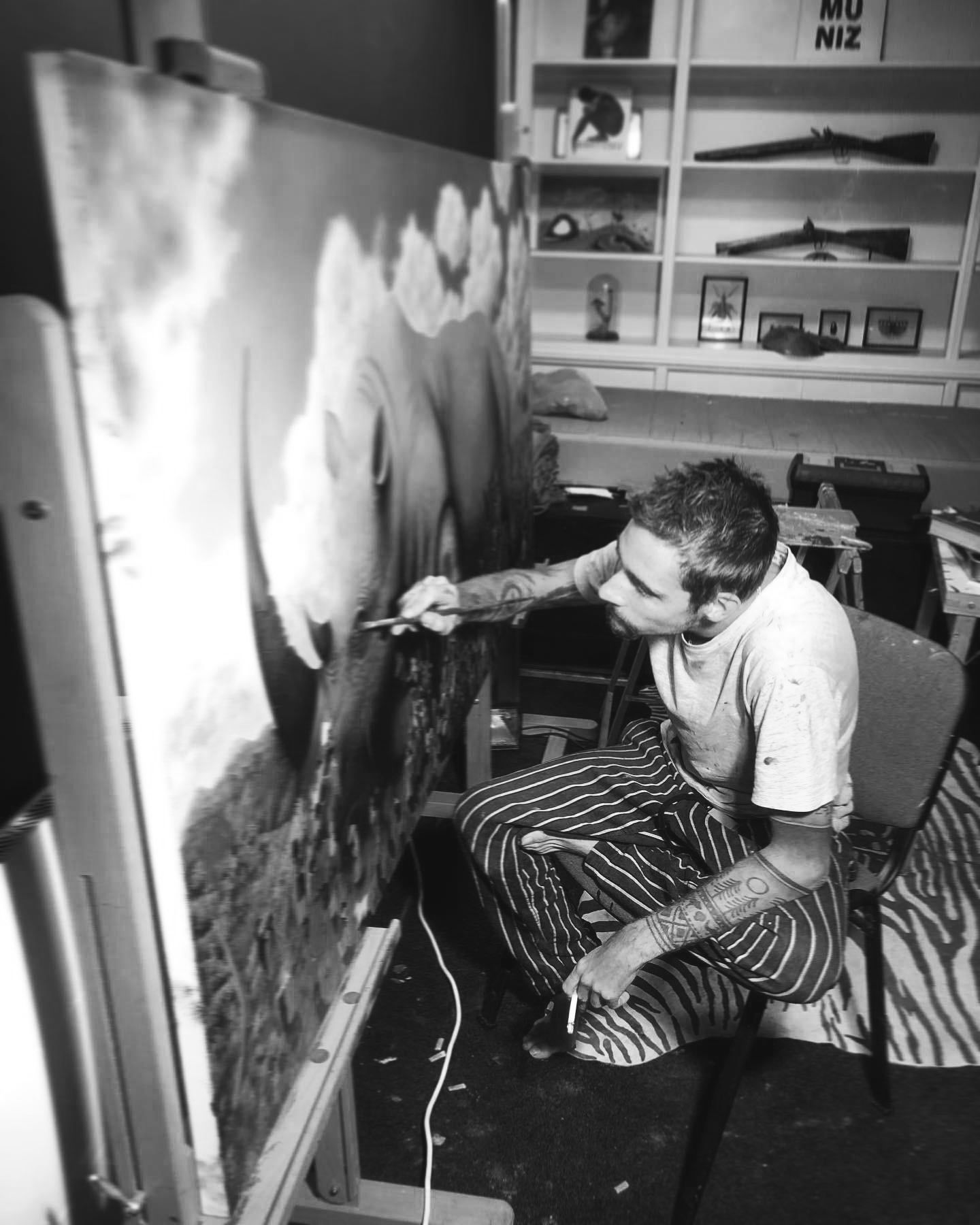
The Artist
SALVADOR
A contemporary visual artist based in Portugal, working between classical figurative training and a surreal, imaginative vision. His practice moves freely between charcoal, soft pastel and oil — always returning to drawing as its first language.
From a very young age, drawing felt natural: a minute of free time meant a pencil in hand, on whatever was at hand. Sculpture, painting, video and music followed, but the line on paper has always been home.
AT GLANCE
A classical path
- 2009Sociedade Nacional de Belas ArtesLisbon
- 2010Slade SchoolLondon
- 2012MEAMBarcelona
- 2013Independent studio practiceFlorence
- 2013–2016Florence Academy of ArtFlorence
- 2016–2019Angel Academy of ArtFlorence
In his own words
Before Florence and Angel, my formal training in the arts was short — a year and a half at MEAM in Barcelona, working thoroughly through the Charles Bargue method, deepening my craft in charcoal and pencil drawing. I had always been drawn to drawing from a very young age; I feel I've always had a natural talent across the crafts — sculpture, painting, drawing, directing video, writing music — but drawing was always the most natural to me.
Until I began my classical studies in Florence I had worked almost exclusively in black and white. I had made many pieces in colour, but mainly abstract, or in graffiti — completely separate from my drawings. Only then did I marry my drawing skills with colour, bringing the work to life not only in shape and tone but in colour, and since then I have ceaselessly worked in oil on a series of large surreal figurative paintings, strongly detailed.
Along the way I stumbled into soft pastels, and have taken a short break from the oil series to close an exhibition exclusively on soft pastel. My journey with the medium has been fascinating and eye-opening to the infinite possibilities of different and mixed mediums to explore. With my ease for moving between mediums and my love for the surreal and imaginative, I see my life bringing wild but always figurative work, in infinite concepts and forms.
Working alone in a studio in Florence gave me the chance to begin painting in oil and in colour, on a series of surreal figurative works with no rules and no boxes. It let me feel the medium before being burdened with the weight of classical painting — a freedom I think was important before embarking on the academies.
I had the opportunity to learn classical drawing and painting in both the Florence Academy and the Angel Academy. They diverge in two techniques — Florence works in sight-size, Angel in comparative measurement — and both, in their own way, are essential. Having had the chance to work in both gave me a great deal of skill in the craft. I have always placed imagination and creativity on the top shelf of the arts, but the skill set from this education was essential to make my projects as true as possible to my vision.
Working through the three pillars of the academic arts — still life, master copies and live model — I now think the academies did the exact opposite of adding weight: they eased the effort of bringing my vision to life. I still believe the academies can be powerfully trapping for a surrealist and creative artist, in atmosphere and in work, but 100% worth the risk if you never let the creative process — or rather the dream — die off, or be blunted down. The mix between the classical and the imaginative is, to me, an explosive combination.
Vision
"The mix between the classical and the imaginative is an explosive combination."